Tuesday, 4 May 2010

Film Classification

When looking at our Thriller we also looked at what certificate we would give it if it were to be distributing it to the public and which one we should try and create it around, depending on which one we believe would obtain the correct audiences. I researched into the different classification groups to see what the film must feature to fit into which one - The British Broad of Film Classification has been classifying films since 1912 and offer us the guidelines, showing details of each classification which are; U (universal), PG (parental guidance), 12A (aged twelve accompanied by an adult), 12, 15 and 18.

http://www.bbfc.co.uk/downloads/pub/Guidelines/BBFC%20Classification%20Guidelines%202009.pdf


After exploring these ratings and their boundaries, i feel the 15 classification is the perfect rating for our film. It contains violence and horror, however this is not looked into in enough detail for an 18 certificate to be necessary. I have included the issues below in which would cause our film to fall into this boundary.


Language: There may be evident use of strong language in our thriller, that persons under the age of 15 should not be permitted to hearing. However, language in which would be classed 'extremely strong' will not be used very often, if at all - this may cause the film to be suitable for 18 years and older if this was referenced frequently.

Horror/violence: this has been included, but dwelling on the infliction of pain is not often used. Also, techniques used to harm yourself is unlikely to be acceptable for this audience and therefore should not be made accessible to viewers - this includes things like, hanging yourself or killing using easily accessible weapons such as a kitchen knife.

Nudity and scenes of a sexual nature: this could beneficially be used in our thriller to help convey the love 'del' and her particular boyfriend have for one another before twisting the event, in a sexual context although this must not be of strong detail. There are no constrains on nudity in a educational or none sexual, however it will often remain fairly brief.


Theme: no particular theme is prohibited within the 15 classification as long as they convey with the rules above, allowing our thriller to fit in here and remain a psychological and criminal genre.


Camera shots/angles

Every film or television programme is made up of multiple shots and angles that are put together in sequence to create the story line. When talking or reviewing a shot, the length, angle and movement of each need to be considered. We needed to look at these before filming our thriller, learning which ones would be best to use and when. After researching these i decided to take some examples using my camera.

The most common shot/angle types include:

Extreme long shot: also known as an establishing shot.

This is most often used to set the scene indicating where the particular film or television programme is taking place. They may often be shots of famous land marks to show where the action is taking place such as Big Ben to identify London for example. This shot can also be used to convey big action scenes, allowing you to see all of what is going on, when representing a war is an example. There is usually very little detail visible in this shot, as it is normally intended to give general rather than specific information.

Long shot: also known as a wide shot


This is a shot in which you are close enough to see a particular character or object whilst still placing the emphasis on the environment - usually aiming to create a link between the two. This typically shows the entire object or human figure and the surroundings around them. The second example here could be said to be a long-medium shot - being in between the two.

Medium shot:


This shows the particular subject in some detail, whilst still allowing some of the setting to be seen. For example if it were a person we were being shown, they would usually be able to be seen down to their waist, leaving the legs off which could be seen to be unnecessary anyway. This is appropriate when the subject is speaking without much emotion or concentration. This shot also allows movement such as hang gestures to be seen and is a natural looking shot. The second example is of a medium two shot - referring to a shot with two people in the frame.

Medium-close up:


This is a shot in between a medium shot and a close up, allowing you to see the subject in more detail without you getting uncomfortably close.

Close up:


This is when a certain feature or object takes up most of the frame. They are particularly useful in showing detail and causing the audience to focus on a specific things, often used with cut-ins. (specifically showing a certain part of the subject) They are usually used to emphasize a persons state of mind, exaggerating facial expressions to convey emotion, almost taking you 'inside the mind' of a character.

Extreme close up:


This gets very close to show extreme detail. It is to close to show emotion unless it is a very dramatic scene and you would usually need a specific reason to use one of these. However, they can be beneficial when you really want your audience to see something - this shot could also be used in horror and thriller films, as they can sometimes cause confusion being so close effectively. An eye opening is often an example of an extreme close up or even a tear running down a cheek.

Two shot:

This is a shot of two people, a natural way of introducing them and is good for establishing a relationship between the two. They will usually have an equal stance and distance in the frame, implicating equality however this is not always the case. They can also be used to show that one person is domineering over the other by the stand they are positioned in, with perhaps one standing up and one sitting down for example.

Over the shoulder shot:

This places you behind a subject who is looking at another one in front. We are shown the back of a person, typically placed in the frame about 1/3 of the way and the other will be almost facing the camera due to looking at the subject we are placed behind, taking up the rest of the frame however this can vary slightly. This helps give you the feel as though you are looking at the person by the others point of view and helps establish the position of each person.

Point of view shot:


This shows a view from the subjects perspective, showing what the character is looking at. Sometimes this is taken over the shoulder of the person with them remaining in the frame.


Ariel shot:


This type of shot is usually taken from a plane, crane, balloon etc often used to show dramatic pans and are beneficial when wanting to view large landscapes. For example, when shooting a scene above the top of a building this could be used to show just how high up they are and there proportion to the rest of the surroundings. The example used is an image taken when we were looking into the location of our thriller.

The Strangers Trailer


As well as watching a number of Thrillers when looking for ideas and inspiration, i also looked at trailers, as i found these tend to include a lot of there best clips, using these to promote there film. I particularly liked 'The Strangers' trailer.

They imediately introduce us to a house, that looks warm and cosy due to the night lights that are on and the carefully cut grass surounding it, however, the camera shakes perposlely, disorientating the audience slightly and giving us the sence that someone is holding the camera itself, looking into the house. Non-diagetic sound also plays straight away, making us aware that something is going to happen and that the house is or will perhaps not be as happy as it first seems.

It cuts to a close up of the bed with romantic leaves on in what we asume is inside the house we have been looking at from the outside. There is a panning shot done of this, effectively changing into a panning shot of lit candels on the table. There are alot of fast cuts present here as we are shown a man proposing to a woman - this is all very cleverly done. Using binary oppositions to effect the audience. This is also a good way of showing how happy and close the couple living in this house are, allowing us to get to know the characters and therefore worry more than we would have done.

The door bangs and there is a medium reaction two shot, showing panick in the couples faces. A voice over can also be seen, asking a question which is cleverly narrated, asking a question in which the audience are also thinking, again causing us to relate to the character and showing she is just like one of us.

I particularly like how the music fades before stopping as we see a person in a mask behind the woman in which she has not seen yet. The silence allows us to hear her sign, hearing her fear. This is also used to scare the audience with the music itself, starting the music again loadly, rather than gradulary as we cut to another shot, causing us to jump. Near the end of the clip we also hear a record playing, using this as background music now as we cut away from it - it seems to be of a child singing and relates slightly to victorian times, somehow making it feel extreamly scary. Lots of fast editing is done here as the record playing is made to sound like it is being moved and distorted, repeating the lines it has already said.

This trailer in particular shows the effect of diagetic and non-diagetic sounds and how important they can sometimes be. It is very cleverly used here and i will try and make as much use out of sound as they have when doing my opening.

Organising our Filming

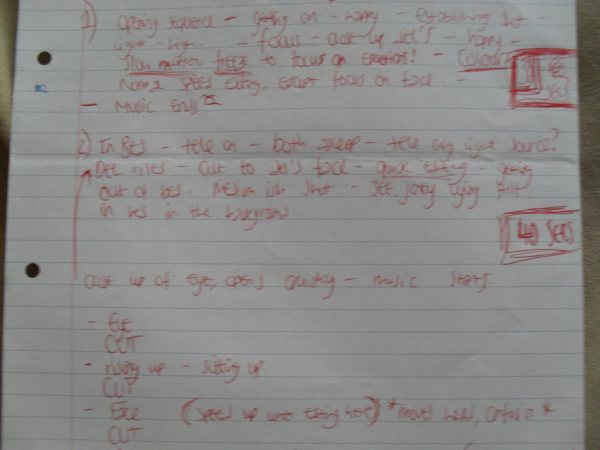
We created this table, using it as a simpler version of a call sheet, which is what we have previously seen when looking into the planning done when creating films that are being distributed to the public. - we chose to create our own table and plan rather than filling out one of this, believing that for us, this is a simpler presentation and only including the things we need to know. This was combined with written notes, explaining exactly how and when each cut was going to be done.


Watching the natural lighting before completing our media we agreed that it was not dark enough outside until around eight and became to dark about half past ten, eleven, therefore aiming to complete the parts we needed to do outside within this time. Di spite this we chose to meet at seven on the nights of filming as this would ensure we had everything as we wanted it, including the surroundings and mise en scene. As well as the props listed above, we will also use bits and bobs around the house that we choose to include in the shot, such as mobile phones placed on the desk for example, as this would be particular of a teenage girl. We will also remove unnecessary props and ensure that nothing could be seen that we didn't want to be.

When thinking about our props, we looked at how we would make the two shots of me with the other teenage boys realistic and ensure that it did not look like we knew we were on camera. To achieve this, we chose to catch us doing something that we would usually do, like watching TV. We decided that we would show me with Simon outside, accompanying him whilst he has a cigarette, knowing that this is something he would usually do.

We hope this will help us when filming and ensure that everything we want to be filmed is included. Choosing to film bits that are in the same place, even though they do not run after one another after editing will hopefully save us time and also make it look more efficient, ensuring the lighting is even.

Forms and Conventions

We watched and analysed a number of films relating to the thriller genre, believing this would be beneficial, enabling us to get an idea of what the typical forms and conventions of successful thrillers are. The films we watched included; seven, taking lives, pscho and one hour photo. I also looked at some at home such as Law Abiding Citizens, the Orphan and Eden Lake. The key elements that were visible in these were looked at:


  • Music: non diagetic music is used very frequently in which usually begins slow, gradually quickening its pace causing a more dramatic climax. The music could also take on a happy tune, using binary oppositions to effect the audience. This allows a build up of tension and can have a huge effect on the audience.

  • The pace of shots is usually quick with lots of action. These action scenes are emphasized a lot, making the scene more entertaining and dramatic.

  • There are often twists used within a thriller, creating the audience to become shocked. This keeps them interested and more involved within the story if something happens in which they are not expecting. This is particularly seen in 'Taking lives', proving to be a very good technique.

  • Stereotypically, a mail character usually plays the antagonist. it is also apparent that the villain must not attract failed expectations as they must seem emperor most of the time, failing this would reduce the reaction from the audience as they will not find him as scary.

  • There was some kind of victim seen in all of these films in which the audience are made to feel sympathetic towards. This proved to be effective as in doing this, the audience are much more involved with the story, pleading that this person is okay. In Law Abiding Citizens, this sense of sympathy is used extremely well to confuse the audience - a man who is initially the villain kills another mans wife and child. The man who lost his family, goes on to kill in remorse so although he was originally the victim, the tragedy he faced turned him into the villain, confusing the audience as they are unsure what their feelings are towards him.

  • lighting was used to effect the mood efficiently in most of these, tending to exaggerate the lighting in one direction - either low key or high key. This adds mystery as it makes the room or environment a little unclear.

  • psychological elements are looked at, allowing the audience to get an idea of what the characters motives and actions are, due to clues and facial expressions.

  • Either the audience or a further character is often included, who give the film a slightly detective feel, aiming to figure out the crime that has been committed, if there has been one.

Looking at and observing these films helped dramatically when thinking about our plot and the filming and editing we would be doing, giving us further ideas and adding to the understanding of the thriller genre.

Plot and structure

A young teenage girl with psychological issues will be the main character within our Thriller and will need to be featured with a number of boys, showing that she has killed more than once - realising that we will have to keep this piece short, we settled on two. We desided that we would introduce the characters quite quickely, ensuring that the audience know who they are, using text to help explain this which will overlap the clip. We will firstly show the main character with the first victim (Simon) looking happy and smiling, showing that they were friendly, however, the text will then explain how this boy has been missing for a while, using this senerio as our flash back. Still-clips will be created to enable us to place the text over the clips.

This scene will be repeated again, being much the same, but showing the girl with the other teenage boy, in which will be the main and present story throughout the opening of our thriller. The girl (Del) will be shown asleep in bed next to her current boyfriend (John). We will then see her awaken in the night and leave the house. She will ring John from outside and clips will then be shown of him searching the house for her, confused at why she is not home and why she rang him. There will then be a cut back outside, showing Del walking back towards the house with a club (the weapon). As this is happening we thought that it would be a good idea to place the flashbacks in here, in which will be shown in a grey colour. John will leave the house in search for her as they meet outside, he will be lead behind a shed, in which he is then killed.

We will then show Del waking up in the morning, confused about where John is, proving that she has no recollection of what she had done the previous night. The film will be titled 'Oblivious Repetition' relating well to this. The film itself will have quick editing and lots of cuts, adding to the disorientation of the audience.

Monday, 3 May 2010

Planning our Thriller


Having realised the importance of planning in relation to filming when doing our practice piece, we ensured that we were fully organised before using the camera. This would ensure we had a full understanding of what needs to be done on what day, the timing in which everything needs to be filmed at in relation to the lighting and mise en scene that needs to be created and the exact clips that need to be shot, so that nothing is missed out. In doing this we will hopefully save a lot more time and the organisation will be evident when watching our final piece.

Firstly, we looked back at the sub-genres we had come across when researching thrillers in general and discussed which ones we believed we could create effectively before concentrating on two in particularly. We liked the idea of a psychological sub-genre, however we were also interested in including a crime and mystery sense within this, aiming to combine the two together. We looked at both of these in more detail to consider how this could be done to its best.

  • Psychological sub-genre: we understood that this element of genre often included mystery and drama to enable it to establish the particular effect it was looking for and we took this into account. Having watched a lot of thrillers to enable us to associate ourselves to the experienced writers and understand the effects they use, i have seen that this particular sub-genre focuses much more on the characters themselves than other thrillers. Most tend to look at characters as being representations of a particular stereotype rather than looking at them as an individual and there personality, mostly using the surroundings to create the thrill they are looking for. I much prefer this, believing that the audience would have a larger reaction if they are able to relate to a character and become interested in wanting to figure them out if they are brought to their attention more often. I also read that although there tends to be two or more characters messing with each others minds here, it can sometimes be that one character alone needs to learn to resolve conflicts and control there own minds, relating to spilt personalities perhaps.

  • Crime sub-genre: this is a suspenseful account of a successful or failed crime and often concentrate on the criminal or victim rather than the person trying to prevent it. This could include any element of crime such as bank robberies, escaping from prison, murder, rape, abductions etc. we will try and include one of these elements within our opening of a thriller, helping to convey the psychological issues our character will have, having the ability to carry one something like this. This would also help us widen the audience in which would be interested in our thriller, making it interesting to a wider range of people.

After much thought we briefly outlined that our story would be about before realising that we needed to decide on a location before planning further, enabling us to make as much use out of this as possible. We wanted somewhere that looked unusual and different from those locations that i found a lot of media students tend to use. We also wanted to be sure that no one else would be familiar with this location, keeping the mystery element in which we wanted our thriller to have. When considering the clips we wanted to be shot, we needed to show a house within a scary environment as the audience would have to be able to see both at the same time to help them to establish a link between them both. Knowing this, we understood that we were unable to film around more than one house and therefore housing estates seemed highly inappropriate, as did any busy environment. Ideally, we needed to find a house that seemed to be in the middle of nowhere, situated away from civilisation - a scary element to include within a thriller in itself. Living in Baswich we realised that it would be difficult to find what we were looking for due to the street lights and amount of houses that were situated far to close to one another. We decided to travel to Brocton to do our filming, remembering that a friend lived there, situated around what we believed would be perfect for our particular thriller. We found a number of interesting locations around here, believing that we could make much use of not just the land, but of the creaky doors and the slightly Victorian look of the house itself. We believed we could make good use of the moody lane, leading towards the house and of the half broken fences which looked particularly scary. This location gave a real sense of chill and perhaps even confusion, idyllic for our thriller.

Having decided on the location and realising what would be effective here, we then developed our plot around this. We asked lots of people what kind of story line they would prefer to watch in relation to thrillers, both media students and others not associated with this cause and found that a high percentage of them would like a psychological element to be included. We went on to develop this. We decided that i would act as the main character and would suffer from psychological issues, being oblivious to whatever crime it would be that i would commit. We believed this would make an interesting opening to a thriller.

We went on to create a detailed account of our film ensuring that all the factors were considered and thought about. These factors include; Mise en scene, costume and make-up, location, characters, audience, the danger/threat, audio and lighting and the shots and editing we would use.

Mise en scene: the majority of the film will be set at night and will therefore be dark and not very well lit. It will be situated in an abandoned like house around large fields, giving us plenty of space to work with. The dark alley ways will also be made use out of in which the character will be seen walking back to the house by. The surroundings will be scary with a secretive feel and it will be quite. Diagetic sound will help convey this. We want the main character to seem normal during the beginning of the opening, enabling the audience to relate to them, because of this we will ensure that the props within the shots that can be seen in the house are what would usually be there.

Costume: the main character will be in her pajamas, as due to the filming being done at night this gives it a realistic feel, also adding to this feel of normality, the character will also have no makeup on, as this would have been taken off before she went to bed. Due to her going outside in these however, shows that she is a little confused and would be seen as unusual, disorientating the reader a little perhaps. We will also aim to exaggerate this, showing clips of the characters feet and that she does not have any shoes on even though she is walking in the mud and having her in a short sleeved top rather than a long one, making the audience believe that she would be cold, yet has not put a jumper on for example. Ketchup and make-up elements will be used in the killing scene, hoping to show the pain he must be in and to try and make it look more realistic.

Location: this has previously been discussed. The house will be old and Victorian like, fitting in with the surroundings. The surroundings will be quite and only land and sheds will be seen.

Characters: due to our plot, we need two further characters (victims) along with the main one (villain). We wanted these characters to be around the same age and represent what we believe to be typical of teenage, using them as stereotypes in some way. We decided on two friends that were willing to help, both aged 18. The main character will be me, aged 16.

Audience: this has been considered throughout the planning. We decided to try and aim our thriller to suit the fifteen and over label, making it thrilling enough to be effective, rather than only being able to use small horror elements. We will use effective shots which we believe will convey what we want to the best and will also ensure that our film can be understood to some extant although we still want them to be left with questions to ask afterwards.

Danger: due to the shortness of the film, the audience will be evident of the danger quite quickly, however we still aim to not give to much away and leave the audience slightly unsure as to why the main character is doing this. Having come across a number of effective techniques, we also decided that we would tilt the camera slightly in some cases, to somewhat, distort the audience.

Sound: we would definitely use non-diagetic music throughout our clip, believing it helps give across the mood and create a more scary atmosphere, particularly in relation to a thriller. Due to our environment we will be filming in, we will also include some diagetic sounds - ones heard in the background as these tend to be quite scary anyway, such as the creaky sound when opening the doors etc and we will also include a few lines of dialogue. We aim for the music track to fit in with the film efficiently and intrigue the audience.

Lighting: We will use very low key lighting when doing the outside scenes, causing the audience to have to concentrate fully however we will sure that the characters and what is going on is still visible. Most of our footage will be in the dark, and due to there being no natural lighting, this allowed us to control where it would be coming from etc. We will use the natural light in the morning scenes, but again, it will also be controlled within the house when it is dark. We will also use this effectively when editing, as having flashbacks in our piece, we will be changing the lighting of these sections to make it clear.


Shots/editing: we will aim to have a number of fast clips, helping to convey the amount of action happening on the killing scene. There will be two shots evident and close ups will also be effectively used, to help show the emotion of the characters.